

Nora Suárez Marcos: The Asturian Who Rewrote the Spanish Record Books
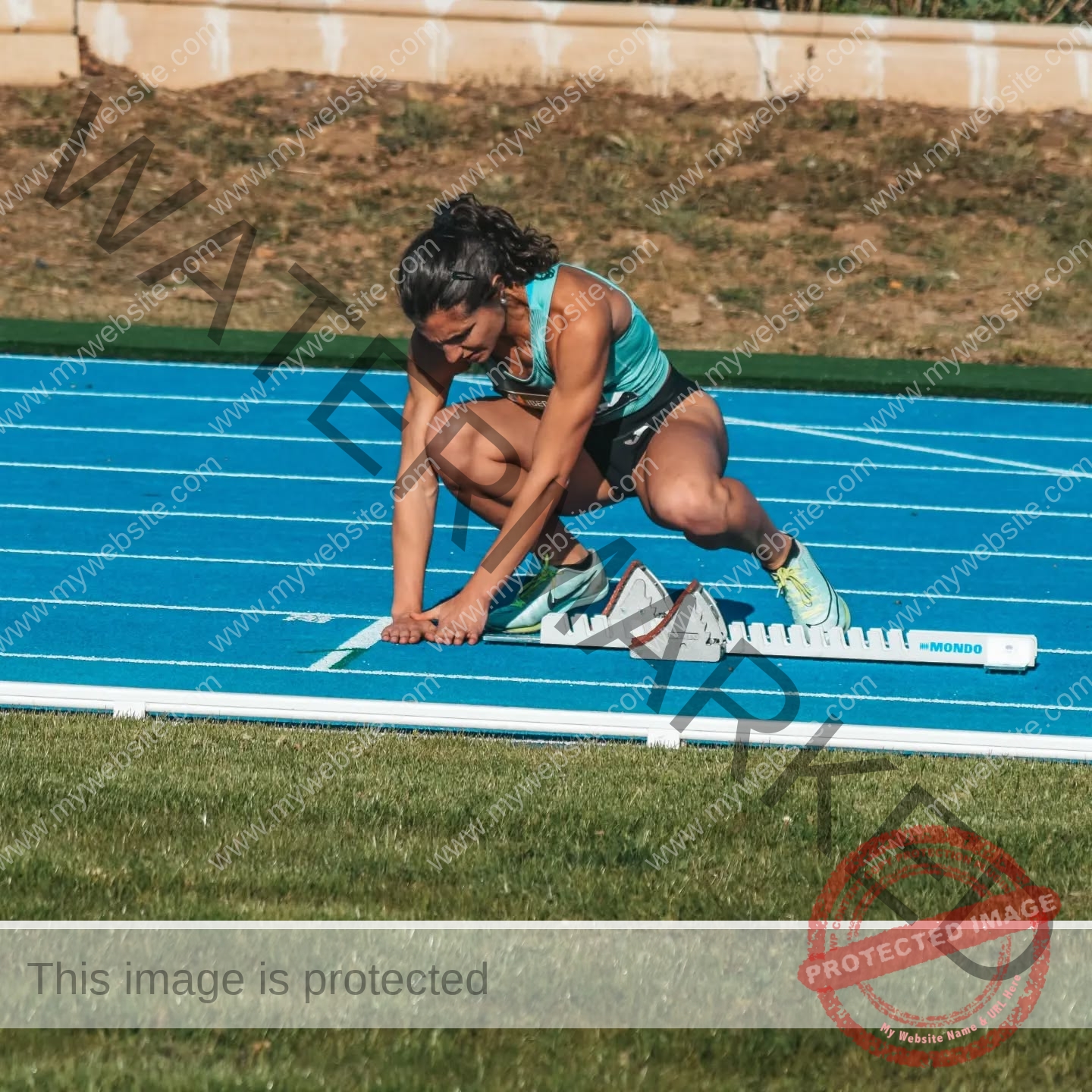
In January 2024, at an indoor athletics meet in Antequera, Spain, Nora Suárez Marcos did something no Spanish woman had ever done before: she ran 400 meters of hurdles in under sixty seconds indoors. Her time of 59.53 didn’t just break the national record — it shattered a barrier that had stood in Spanish athletics for as long as the indoor hurdles had been contested at the national level. In a single performance, the hurdler from Asturias announced herself to the country’s athletics community in the loudest possible way.
That moment was the culmination of a long, steady, and quietly impressive career — one that had begun far from the spotlight on the tracks of Gijón, wound through the university athletics system in León, and eventually landed at one of Spain’s most ambitious club programs on the Mediterranean coast of Andalucía. To understand Nora Suárez Marcos is to understand a particular kind of athlete: one who is relentlessly versatile, stubbornly competitive, and constitutionally incapable of giving anything less than everything she has on the track.
Origins: Asturias and the Making of an Athlete
Nora Suárez Marcos was born on April 27, 1995, making her thirty years old as of this writing. She is Asturian by origin — a daughter of northern Spain’s green, rain-soaked principality, a region better known for its mining history, its cider, and its dramatic coastal cliffs than for its track and field tradition. Gijón, the industrial port city on Asturias’s Bay of Biscay coast, is where her athletics career began to take shape, and she has been referred to as “asturiana” and “leonesa” interchangeably by the Spanish sports press — a reflection of the fact that her competitive life has carried her across the regions of northern Spain, from Asturias to León and eventually to Andalucía.
The exact details of how she first came to athletics are not extensively documented in the public record, but what is clear from even the earliest coverage of her career is that she arrived at Gijón Atletismo as a young woman already in possession of something rare: a genuine multi-event athleticism that set her apart from most of her peers. She didn’t just run the hurdles. She ran the 100 meters, the 200 meters, and the 400 meters flat. She competed in relays. And she took to the pole vault — not a discipline typically associated with 400-meter hurdlers — with enough competence to draw attention.
The Gijón Atletismo blog, which chronicled the club’s athletes in enthusiastic, affectionate detail, published a pair of posts about Suárez Marcos in 2016 that capture something essential about who she was as a young athlete. Written in the informal Argentine Spanish of the club’s blogger — Gijón Atletismo having a distinctly eclectic personality — the posts describe her as a revelation: an athlete with immense talent, ferocious competitive spirit, bulletproof courage, and a warmth and charm that made her beloved within the club almost immediately. One post was titled, simply, “Condemned to Success.”
The occasion for that particular piece was a remarkable sequence of events at a second-division national championship in Castellón. In the 400 meters hurdles, Suárez Marcos had been leading the race comfortably when she hit a hurdle and fell hard — a crash described by the blogger as almost bouncing her off the tartan track surface. Nearly anyone else, the post notes, would have stayed down. Suárez Marcos got up. She resumed the race. She cleared the remaining hurdles — albeit not without some difficulty from the pain and disorientation of the fall — and crossed the finish line, salvaging a valuable competition point for her club. Then, just minutes later, before her body had any real chance to recover, she lined up again for the 4×400 relay. And she flew, delivering the baton in first place.
That story says as much about Nora Suárez Marcos as any biography paragraph can. It is the story of an athlete who, when the race is on, simply does not stop.
The Gijón Atletismo Years: Versatility and Early Recognition
During her time with Gijón Atletismo — which corresponds roughly to around 2016 — Suárez Marcos was described by those who watched her as one of those genuinely special young athletes whose ceiling is difficult to estimate precisely because they do so many things so well. The club blog repeatedly emphasized her versatility: the pole vault, the sprint events, the hurdles, the relay legs. She competed across all of them and performed well in each.
The milestone that stood out during this period was earning the minimum qualifying mark for the Campeonato de España (Spanish National Championships) in the 400 meters. According to a second Gijón Atletismo post from that summer, she achieved it through a characteristically industrious sequence: a victory in the 400 at a meet in Getafe, Madrid, on a Monday, followed by a return to Avilés — just two days later — to run the qualifying time that punched her ticket to the nationals. The blog described it as a “well-deserved achievement” and praised her not only for her talent but for her training discipline and her character.
She was already the kind of athlete whom coaches and teammates point to when they want to talk about what the sport looks like when someone is doing it right.
The University Years: Moving to León
At some point in her late teens or early twenties, Suárez Marcos made the move that would define the middle chapter of her career: she relocated to León, the ancient city in the central-northern meseta of Castile, and joined Universidad de León Sprint Atletismo — commonly known as ULE Sprint. The club is closely affiliated with the University of León and has long been one of the more competitive women’s athletics programs in northern Spain, competing in the División de Honor, the top tier of Spanish club athletics.
The university championship record provides one fixed data point from this transition period: at the 2018 Campeonato de España Universitario de Atletismo, representing the Universidad de Oviedo (UOV), Suárez Marcos finished second in the 400 meters hurdles with a time of 1:02.00. The result places her firmly within the university athletics pipeline, still improving, still finding her ceiling.
Her years with ULE Sprint, which extended through at least 2023, represented a steady and meaningful phase of development. The club competed at the highest levels of Spanish women’s athletics, and Suárez Marcos became one of its most consistent contributors — not only in individual events but as an anchor leg relay runner, a role that requires a particular combination of speed, tactical intelligence, and composure under pressure. She proved to have all three.
The club’s documentation of her contributions during this period shows up repeatedly in press coverage from León. She is listed among the club’s notable athletes at regional competitions, at national leagues, and at championships in Castilla y León. She ran the 4×400 relay leg for ULE Sprint across multiple seasons and helped keep the club competitive in Division de Honor, which is no small feat — that league includes clubs like FC Barcelona and Playas de Castellón, two of the best women’s athletics programs in Europe.
The National Breakthrough: Nerja 2022
The 2022 Campeonato de España Absoluto — held at the Estadio Enrique López Cuenca in Nerja, Málaga, in late June — was the event that first put Nora Suárez Marcos’s name in front of a national audience. She finished fifth in the 400 meters hurdles final with a time of 58.41, a new personal best at the time. In the context of that particular race, it was a result that placed her in impressive company: the winner was Sara Gallego, who broke the Spanish national record with a stunning 54.34 in one of the most celebrated individual performances in recent Spanish athletics history. The silver and bronze went to Carla García (56.54) and Geena Stephens (57.89) respectively. Suárez Marcos, as described in one press report at the time, finished fifth with a personal best — notable, forward-pointing, a statement of arrival.
More memorably, she was the lead-off leg of the ULE Sprint 4×400 relay that day, and what that relay team produced was one of the genuine stories of the championship. Running together — Suárez Marcos, Clara Llamazares Alonso, Alicia Recio Samaniego, and Ángela García Sancho — the four women posted a time of 3:38.45 and won the silver medal, beaten only by FC Barcelona and finishing ahead of Playas de Castellón, a club that had been competing with the best in Europe for years. The ULE Sprint club’s own account of that day called it “a spectacular race” and praised each of the four athletes for running a nearly perfect relay. For an athletics program from León to finish second in all of Spain, ahead of Castellón, was a moment of significant pride.
The Season That Delivered Bronze: Torrent 2023
If Nerja 2022 was the arrival, Torrent 2023 was the confirmation. Suárez Marcos went into the 2023 outdoor season in the best form of her career, and she demonstrated it at the national championships with a performance that earned her the first individual national medal of her athletic life.
She won her semifinal in 58.78 — a clean, commanding run that announced she was in form and ready to compete for the podium. When the final came around, she delivered: 57.63, a new personal best, good enough for the bronze medal behind champion Daniela Fra and silver medalist Carla García. The result placed her among the three best women in Spain in the 400 meters hurdles — a status she had been building toward for years.
The Diario de León described it as “the icing on a brilliant competitive season.” The relay squad added a fourth-place finish in the 4×400 (3:40.71, a personal best for the group), and the overall picture was of an athlete hitting her stride at the national level with no signs of plateauing.
She was twenty-eight years old. The best was still ahead of her.
A Historic Moment: The Spanish Indoor Record
The indoor season of early 2024 became the defining chapter in Nora Suárez Marcos’s career to date. By this point she had made the move to the Trops-Cueva de Nerja program — back, in a sense, to the very stadium where her national breakout had occurred in 2022 — and on January 28, 2024, she competed at the Campeonato de Andalucía Absoluto en pista cubierta (the Andalusian Indoor Championships) held in Antequera.
What she did there had never been done by any Spanish woman: she ran the 400 meters hurdles indoors in 59.53 seconds, becoming the first woman in the history of Spanish athletics to break the minute barrier in the event contested on a short track. The previous national record had never dipped below sixty seconds. Suárez Marcos didn’t just edge it — she broke it with room to spare, posting a time that was, at the time of its setting, a genuinely impressive mark on any European scale for the indoor event.
The Infonerja local news site called it simply: “It had never been done before in this event.” The broader Spanish athletics community took note. That same meet saw her also win the 200 meters gold, further underlining her versatility and her form at that moment in the season.
In February 2024, at a meeting in Gent, Belgium, she added a 53.94 personal best in the flat 400 meters indoors — a time that ranks among the more competitive Spanish marks in the event and confirmed that her exceptional indoor 400 hurdles run had not been an anomaly but rather the product of genuine peak physical condition.
The indoor record for the 400 meters hurdles (short track) stood in her name from January 2024 until early 2026, when Daniela Fra — the same athlete who had beaten her at the 2023 nationals — broke it, first with a 57.40 at one meet and then, days later, with a 57.04 at a competition in Val de Reuil, France. The record Suárez Marcos set had been genuinely pioneering; that it was eventually surpassed by a world-class performance reflects how rapidly the event is developing in Spain rather than anything diminishing about what she achieved in Antequera.
Trops-Cueva de Nerja: A New Home at the Top
The Club Nerja de Atletismo — competing under the sponsored name Trops-Cueva de Nerja, with backing from Trops, a tropical fruit company, and the famous Nerja Cave tourist attraction — is one of Spain’s most ambitious athletics programs. Based in the small coastal town of Nerja on the eastern Costa del Sol, the club competes in División de Honor and has been building systematically toward the top of Spanish club athletics for years. Their women’s team finished third at the 2024 División de Honor final — behind only Playas de Castellón and FC Barcelona — a result that speaks to the caliber of the program Suárez Marcos joined.
For Suárez Marcos, the move to Nerja represented both a geographic and competitive shift. She had built her career in the north of Spain — Gijón, León, Castilla y León — and now she was training and competing in Andalucía, representing a club based in a Mediterranean resort town that also happens to be deeply serious about athletics at the national level. The transition appears to have suited her well. Her performances in 2024 were the best of her career.
The RFEA Liga Iberdrola coverage from 2024 lists her as one of Trops-Cueva de Nerja’s key athletes, competing in both the 200 meters and 400 meters hurdles in Division de Honor competition. That dual role — sprint and hurdles — reflects the continued versatility that has always defined her.
2025: Continuing at the Top of the National Scene
Suárez Marcos carried her form through the 2025 season, competing across multiple events and championship levels. In July 2025, she competed at the Campeonato de España de Atletismo de Federaciones Autónomas, representing Castilla y León, and finished fifth in the 400 meters hurdles with a time of 59.74. She also ran the second leg of the mixed 4×400 relay for that combined regional team, finishing sixth with a time of 3:28.83 alongside teammates Marco Saiz, Bruno Cano, and Alicia Recio. The 59.74 is notable: it represents continued sub-minute competence in the event, further evidence that her January 2024 breakthrough was not a fluke but a genuine new baseline.
The Liga Iberdrola 2025 also saw her remain a key contributor for Trops-Cueva de Nerja. RFEA reporting confirmed her inclusion in the club’s lineup for the first jornada in April 2025, listed as a competitor in 400 meters hurdles — one of a number of high-quality athletes the club fielded that season as they pursued another strong División de Honor finish.
March 2026: A Championship Gold to Punctuate the Season
The most recent chapter in Nora Suárez Marcos’s career came at the inaugural Campeonato de España Absoluto Short Track, held in Valencia in late February and early March 2026. The championship was historic in its own right — the first time the mixed 4×400 relay had been contested as an event at the Spanish national level — and Suárez Marcos was at the center of the moment that mattered most.
Having reached the final of the women’s 200 meters at that championship — confirmation that she remains one of the faster women in Spain at the sprint distances — she turned her full attention to the 4×400 relay for her club, Trops-Cueva de Nerja. Running the second leg, she took the baton in a race that was tightly contested and delivered it to her teammates in the lead. The subsequent legs, run by Alejandro Guerrero and Herminia Parra, consolidated and extended that advantage.
When the team crossed the finish line, the clock read 3:23.58 — simultaneously the record of the inaugural championship and the best mark ever posted by a Spanish club in the mixed 4×400 relay event. It was a gold medal, a national record, and a piece of Spanish athletic history, all at once. The Diario de León — which has followed Suárez Marcos’s career since her ULE Sprint days — captured the moment in print, describing her relay leg as “one of the most solid” of the race and crediting it as the moment that “opened the doors not just to the medals, but to the most precious of them.”
Personal Bests and Career Statistics
Nora Suárez Marcos competes across a wider range of events than most 400-meter hurdlers, a reflection of the multi-event background that characterized her early career. Her key personal bests include:
- 400m Hurdles (outdoor): 57.63 — bronze medal, Campeonato de España Absoluto, Torrent (July 29, 2023)
- 400m Hurdles (indoor/short track, former Spanish national record): 59.53 — gold, Campeonato de Andalucía Absoluto en Pista Cubierta, Antequera (January 28, 2024)
- 400m (indoor): 53.94 — Gent, Belgium (February 3, 2024)
- 200m (indoor): 24.31 — gold, Antequera (February 10, 2024)
- 4x400m Mixed Relay (short track, national club record): 3:23.58 — gold, Campeonato de España Short Track Absoluto, Valencia (March 1, 2026)
- 4x400m Relay (outdoor): 3:37.32 — Tarragona (August 3, 2025)
Her World Athletics profile (ID: 14753117) lists her across 100m, 200m, 400m, 400m hurdles, 60m, and 800m — a testament to the range of events she has contested at the competitive level throughout her career.
The Career in Context
What makes Nora Suárez Marcos’s story genuinely interesting is the shape of it. She is not an athlete who burst onto the scene at eighteen and rode natural talent to success. She is the other kind: the one who got better year by year, who worked through the university athletics system, who kept refining her technique and building her fitness through her mid-twenties and into her thirties, and who kept surprising people at each new level she reached.
The Spanish 400-meter hurdles scene she has competed in is not an easy one. It includes some genuinely elite athletes — Sara Gallego, who was running sub-55 and placing among the top Europeans; Daniela Fra, who inherited that mantle and has continued to push the national record lower; Carla García. Against that competition, Suárez Marcos has been a consistent presence in national finals for years, earned a national individual bronze medal, set a historic indoor record, and won national relay titles. That is a career of real substance.
She has also navigated the geographic complexity of Spanish elite athletics with notable adaptability. Her club affiliations have taken her from Gijón to León to Nerja — three cities in three very different regions of Spain, each representing a new competitive environment and new training context. At each stop, she has not only adapted but thrived.
The Gijón Atletismo blogger who wrote about her in 2016 called her “condemned to success” — a phrase that reads now as prescient rather than hyperbolic. It captures something true about her: the sense that someone with her combination of talent, grit, and competitive fire was never going to be satisfied with anything short of her best, and that her best was going to be something worth paying attention to.
Social Media and Public Profile
No confirmed public social media profiles for Nora Suárez Marcos have been identified as of this writing. No commercial sponsorships have been publicly announced. She competes for Club Nerja de Atletismo, which competes under the banner of Trops-Cueva de Nerja in División de Honor competition. For those looking to follow her results, the RFEA live results platform and the World Athletics athlete profile (code 14753117) are the most reliable sources of current competitive information.
Career Highlights at a Glance
- ~2016 — Joined Gijón Atletismo; earned national championship qualifying mark in 400m; notable fall-and-finish story at Segunda División nationals in Castellón
- 2018 — Silver medal, 400m hurdles, Campeonato de España Universitario (representing Universidad de Oviedo), 1:02.00
- ~2018–2023 — Competitor for ULE Sprint (Universidad de León Sprint Atletismo); multiple appearances in División de Honor and national championships
- June 2022 — Fifth place, 400m hurdles (58.41, then-personal best), Campeonato de España Absoluto, Nerja; silver medal in 4x400m relay with ULE Sprint (3:38.45)
- July 2023 — Bronze medal, 400m hurdles (57.63, personal best), Campeonato de España Absoluto, Torrent; semifinal winner (58.78); 4x400m relay fourth place (3:40.71)
- January 28, 2024 — Spanish national record, 400m hurdles indoor/short track (59.53); first Spanish woman to break 60 seconds in the event; also won 200m gold; Campeonato de Andalucía, Antequera
- February 3, 2024 — 53.94 personal best, 400m indoor, Gent, Belgium
- July 2025 — Fifth place, 400m hurdles (59.74), Campeonato de España de Federaciones Autónomas, representing Castilla y León
- August 2025 — 4x400m relay (3:37.32), Tarragona
- March 1, 2026 — Gold medal and national club record, 4x400m mixed relay (3:23.58), inaugural Campeonato de España Short Track Absoluto, Valencia, with Trops-Cueva de Nerja
