
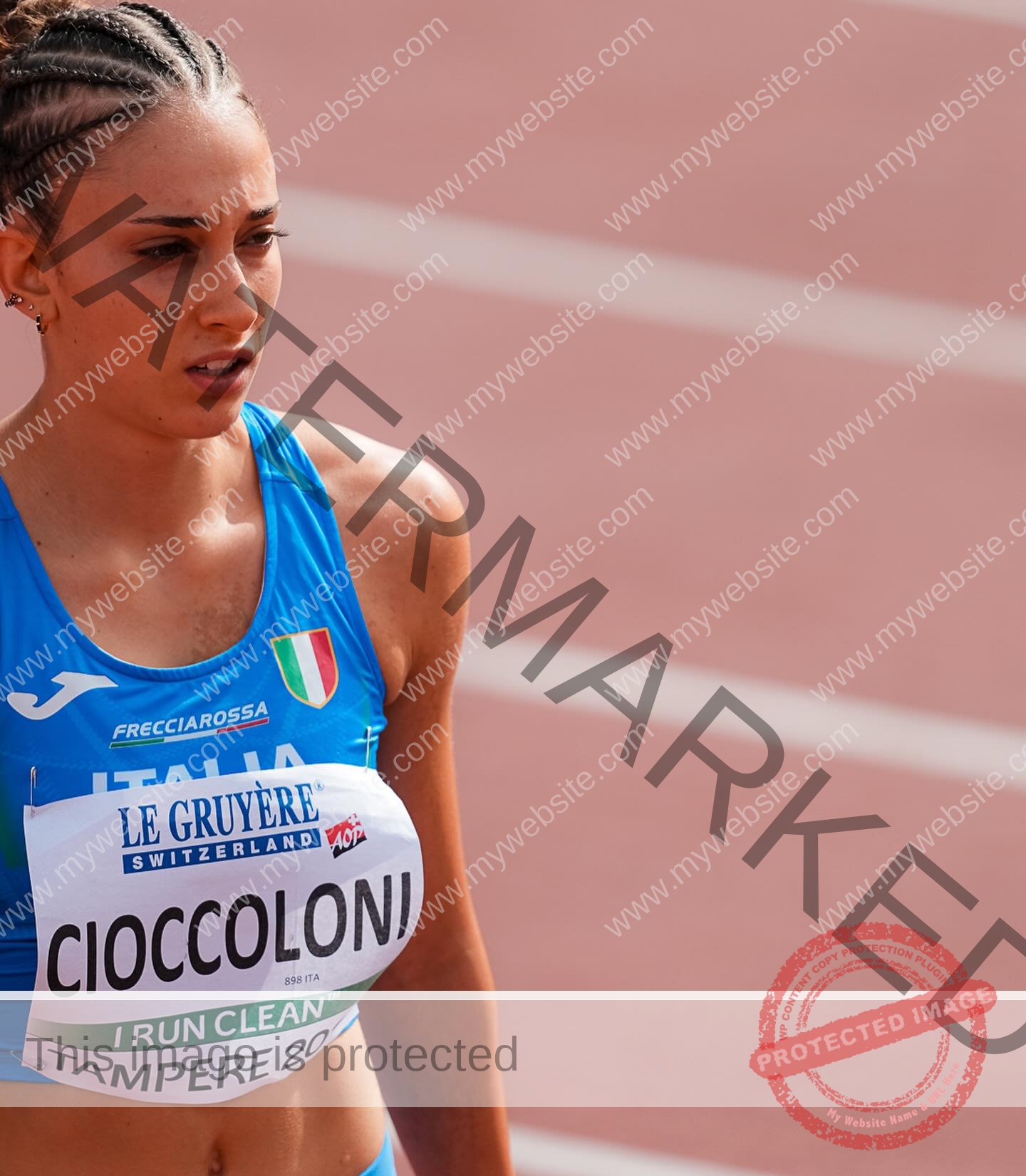
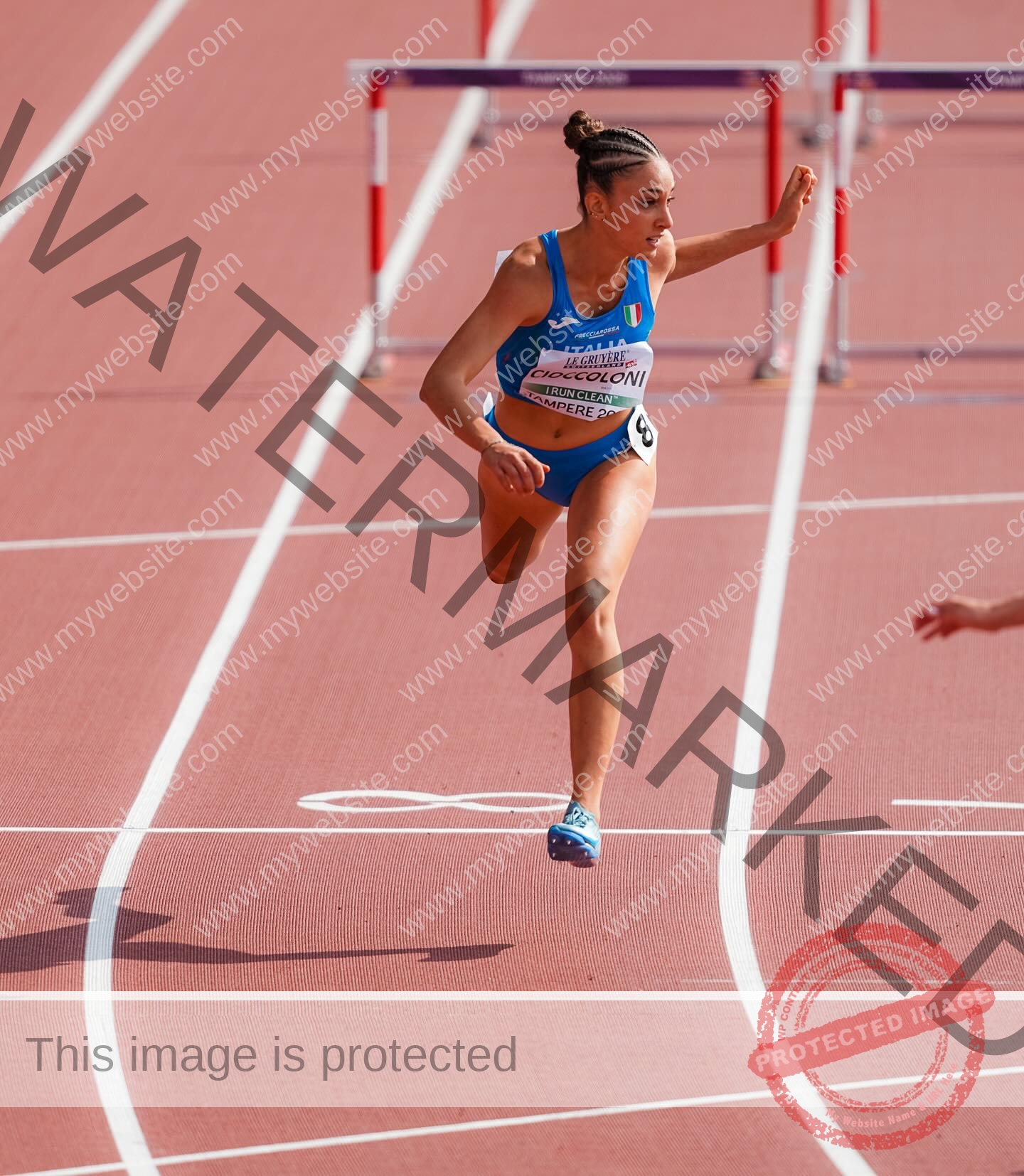
Veronica Cioccoloni: Rome’s Young Hurdler Making Her Mark on Italian Athletics
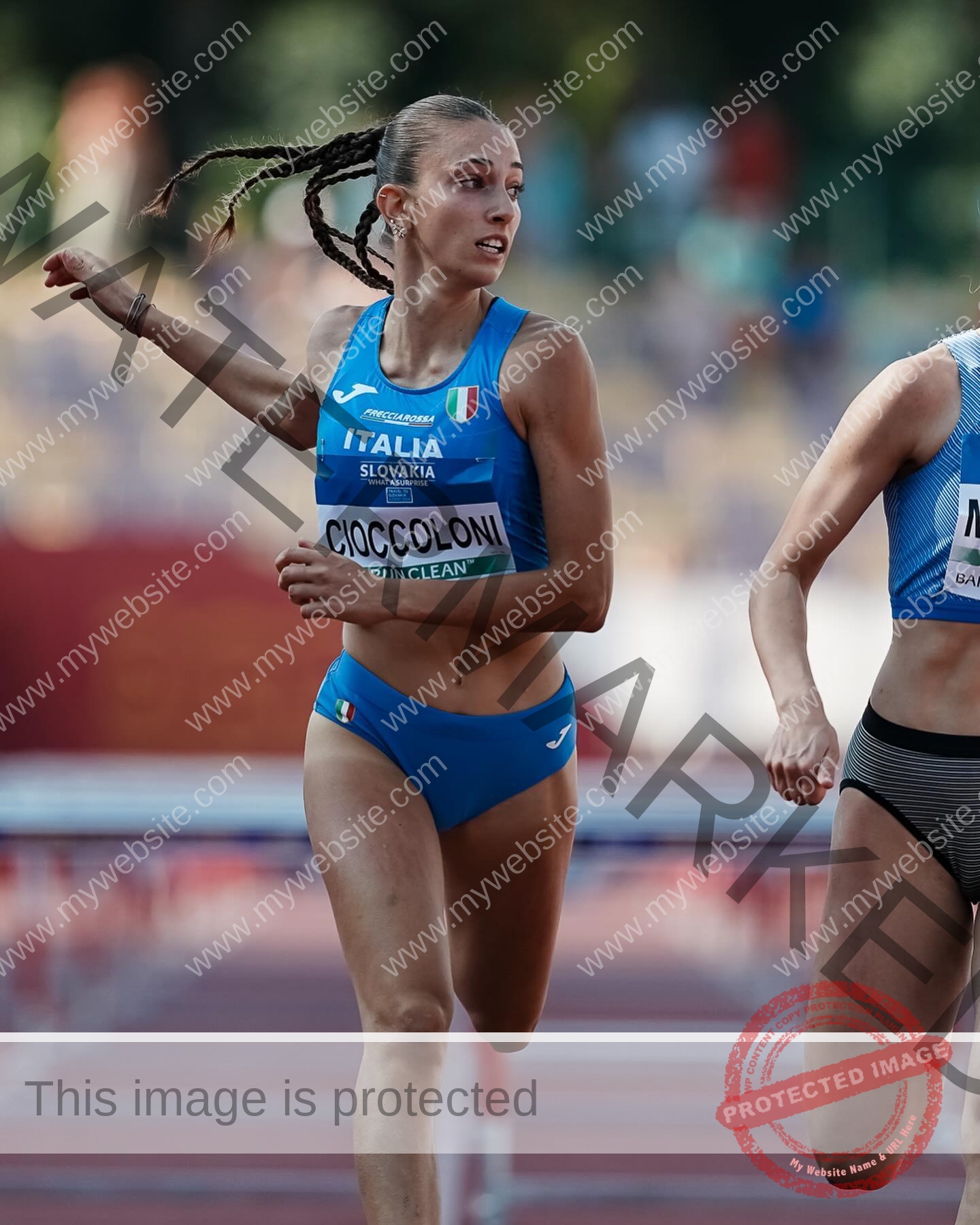
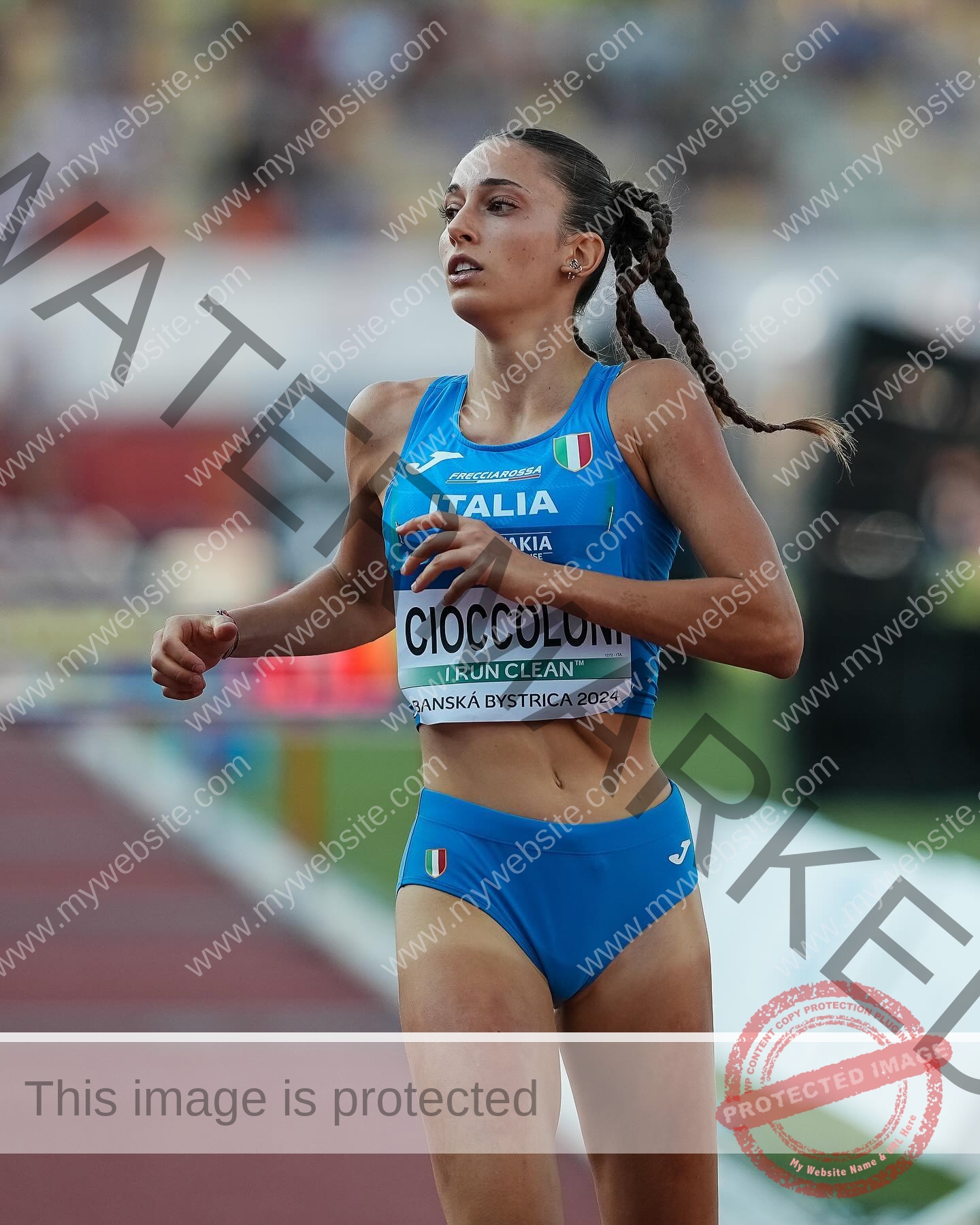
In the summer of 2024, when the Italian national athletics federation published the official start list for the women’s 100 meters hurdles at the European Under-18 Championships in Banská Bystrica, Slovakia, the name “Veronica Cioccoloni” appeared next to a club affiliation that most Italian athletics fans had never seen compete at this level: A.S.D. P. Astra Atletica, a polisportiva based in Rome. She was sixteen years old, one of just two Italian women selected for the event, and — on the strength of a season-best time of 13.58 seconds — the second-fastest junior female hurdler in Italy that year.
She would reach the semifinal. And the club’s own website, proud and unambiguous about its place in the story, would note afterward that “in July 2024, our name crossed Italy’s borders, thanks to the participation of Veronica Cioccoloni, who ran the semifinal in the 100m hurdles at the European U18 Championships.” For a club organized around the motto “Per Aspera Ad Astra” — through hardship to the stars — the international debut of their young hurdler felt fitting.
Since then, Cioccoloni has continued to develop at a rate that justifies the attention. She won the Italian Junior title in 2025, competed at her second consecutive European championship, and entered the winter of 2025-26 as Italy’s leading under-20 athlete in the 60 meters hurdles. She is 18 years old and already a consistent presence on Italian athletics’ most watched lists.
Background: Rome, Astra Atletica, and Early Beginnings
Veronica Cioccoloni was born on September 6, 2007, making her a member of the Italian athletics system’s “classe 2007” — a cohort that has competed at the European Under-18 level in 2024 and has the European and World Under-20 championships ahead as the next major targets. Her hometown is Rome, and she competes for A.S.D. Polisportiva Astra Atletica, a Roman multi-sports club whose athletic section trains under the FIDAL (Federazione Italiana di Atletica Leggera) system within the Lazio regional committee.
Astra Atletica describes itself as a formative athletics environment whose philosophy holds that talent alone is insufficient — the club’s web presence prominently quotes Pietro Mennea, the legendary Italian sprinter and Olympic champion at Moscow 1980: “Sport teaches that talent is not enough for victory; daily work and sacrifice are needed. In sport as in life.” That philosophy, applied to a young Roman hurdler who developed through the club’s ranks, seems to have taken root.
The specific circumstances of Cioccoloni’s introduction to athletics — whether through school programs, family influence, or the club’s own outreach — are not documented in publicly available sources. What is documented is the trajectory of her competitive development, which, from the outside, has the look of an athlete who came to the hurdles with a natural aptitude and then steadily refined it under consistent coaching.
The Event: What the 100 Meters Hurdles Demands
The women’s 100 meters hurdles is one of the most technically demanding events in track and field. Ten barriers, 84 centimeters high in the adult version (76.2 cm at the under-18 level), spaced at precise intervals over the sprint distance. The event requires a sprinter’s raw speed, a jumper’s timing and coordination, and the technical fluency to clear obstacles without breaking stride while maintaining the explosive acceleration of a flat sprint. Elite women in the event run under 12.5 seconds; competitive European juniors run in the 13.0 to 13.8 range; a 14-second hurdles athlete at the high school level is considered talented, and sub-13.5 at the junior level begins to draw serious attention.
The indoor equivalent, the 60 meters hurdles, compresses the challenge into six barriers over the shorter distance, typically serving as a winter development event and a benchmark for early-season fitness. In Italy, the event is contested at the national indoor championships at the junior (under-20) and promesse (under-23) level, and the performances there feed directly into outdoor preparations.
Cioccoloni has competed in both formats since her early career, and her consistent presence near the top of Italian junior lists in both events speaks to a well-rounded technical and physical development.
The Allievi (U18) Years: 2023–2024
The Italian athletics system divides young competitors into age categories — Cadetti (under 16), Allievi (under 18), Juniores (under 20), and Promesse (under 23) — with competition structures and championship events at each level. Cioccoloni competed as an Allieva during the 2023 and 2024 seasons, the two-year window for athletes aged 16 and 17.
Her 2023 season, as a first-year Allieva at age 15 to 16, established her as a competitive presence in Lazio regional athletics. The FIDAL national gradatorie (performance rankings) from that period place her among Italy’s leading young hurdlers with marks in the hurdles, as well as competitive performances across the 100 meters flat, long jump, high jump, and pentathlon — the multi-event that helps young Italian athletes develop breadth before specializing. Her pentathlon bests from this era (3157 and 3376 points, per atletica.me) reflect the kind of all-around development that Italian youth athletics encourages.
The 2024 season was the one that brought her to national and, briefly, continental attention. She ran 13.58 seconds in the 100 meters hurdles — a mark that placed her second in Italy’s allievi category for the year, behind only national champion Vittoria Masiero (13.51). At the Italian Regional Championships in Rieti, a FIDAL report noted her “13.58 (+1.0)” finish in the 100hs allievi category. She also ran 12.69 in the 100 meters flat — the second-fastest allievi mark in Italy that season — indicating a flat sprint foundation that underpins her hurdles performance.
In June 2024, at the Italian National Allievi Championships in Molfetta, Cioccoloni placed third in the 100m hurdles with a time of 13.71 seconds into a headwind of 1.1 meters per second — a mark that, combined with the strong performances earlier in the season, earned her the FIDAL national standard for the European U18 Championships. The Italian federation’s preview for those championships noted that she had run 13.58 — the second-best Italian mark of the season — and would represent Italy alongside champion Vittoria Masiero.
European Under-18 Championships, Banská Bystrica 2024
The 2024 European Athletics Under-18 Championships, held in Banská Bystrica, Slovakia from July 18 to 21, was a landmark event for Italian junior athletics. Italy finished first in the overall medals table with seven gold medals, fifteen total medals, and 145 points in the extended standings — a result described by Italian athletics media as the best performance by Italy in any European or World Youth/Junior championship in the country’s athletic history. The event was electric for Italian fans and produced headline-making performances from names like Kyan Escalona (110mH), Elisa Valensin (200m), and Serena Di Fabio (5000m walk).
Against that backdrop, Veronica Cioccoloni made her international debut. In the preliminary round of the women’s 100 meters hurdles on July 18, she ran 13.68 seconds — fast enough to advance to the semifinal. The qualifying performance, while aided by a wind reading of +2.1 m/s (just over the legal limit for record purposes), was substantive: she finished fourth in her heat and progressed on time.
The semifinal the following day proved more challenging. Racing in unfavorable conditions (-0.7 m/s wind), Cioccoloni ran 13.87 seconds and finished fifth in her semifinal group — one position short of automatic qualification for the final. She was eliminated. Italian sports coverage noted simply that she ran “13.87 (-0.7) in semifinal after 13.68 (+2.1) in the heat,” with the Lazio regional athletics federation’s post-event report summing her effort as competitive but insufficient to reach the final in a deep field.
The experience was precisely the kind that development-stage athletes need and learn from. At 16 years old, racing against the best under-18 hurdlers on the continent, Cioccoloni had qualified through a preliminary round, performed at the semifinal level, and seen the gap between herself and a European final. Her club’s website singled it out as a defining moment: the day Astra Atletica’s name went international.
Italian Championships and the Outdoor Season (2024)
Cioccoloni’s 2024 outdoor season was built around both the national allievi circuit and the European championship campaign. In addition to her 13.58 PB in the hurdles and 12.69 in the flat 100m, FIDAL performance lists from that season record her with a high jump best of 1.59 meters and a long jump of 5.54 meters — marks that place her as a genuinely versatile young athlete rather than a pure specialist. Her pentathlon score of 3376 points from the 2024 season represents a strong multidisciplinary showing for an allieva of her age.
At the Italian Allievi Championships, she featured consistently near the podium level in the hurdles. The Lazio regional federation’s tracking of its athletes confirms her as one of the most significant allievi contributors from the Rome area that season.
Transition to Junior (U20): The 2024–25 Indoor Season
With the calendar year turning to 2025, Cioccoloni aged into the juniores (under-20) category — a significant step up in competition level, both domestically and internationally. The Italian Junior and Promesse Indoor Championships in Ancona (February 2025) offered her first major test in the new age group.
Racing in the 60 meters hurdles at Ancona’s PalaCasali, Cioccoloni ran 8.76 seconds in the heats — placing her fifth among the eight finalists. A preview analysis for the event had listed her as one of the principal contenders: “Delle 35 partecipanti, sono distanziate di pochi centesimi Veronica Cioccoloni 8.62 (azzurrina lo scorso anno nella categoria U18)…” Her semifinal time of 8.76 fell slightly below her best, and she did not win a medal at those championships, but the competitive context was useful: she was now running against athletes with up to three additional years of development, and she was competing.
The indoor season also confirmed that her personal best in the 60 meters hurdles had come down to 8.48 — the mark recorded by atletica.me as her career best — at the PalaIndoor in Ancona. That mark places her among Italy’s fastest junior 60mH athletes.
The 2025 Outdoor Season: Italian Junior Champion
Cioccoloni’s 2025 outdoor season was her most significant to date, culminating in a major individual title that validated the trajectory her performances had been suggesting.
Early in the outdoor calendar, she was making consistent appearances at regional and national level meets, steadily building her season around the Italian Junior Championships at Grosseto in early July. FIDAL’s preview for those championships identified her and Matilde Morbin as the two leading contenders in the women’s junior 100 meters hurdles, describing them as the two Italian juniors already running under 14 seconds — a meaningful threshold at this level. The preview noted: “100hs con Veronica Cioccoloni (Astra Atletica) e Matilde Morbin (Atl. Vicentina) sotto i quattordici secondi.”
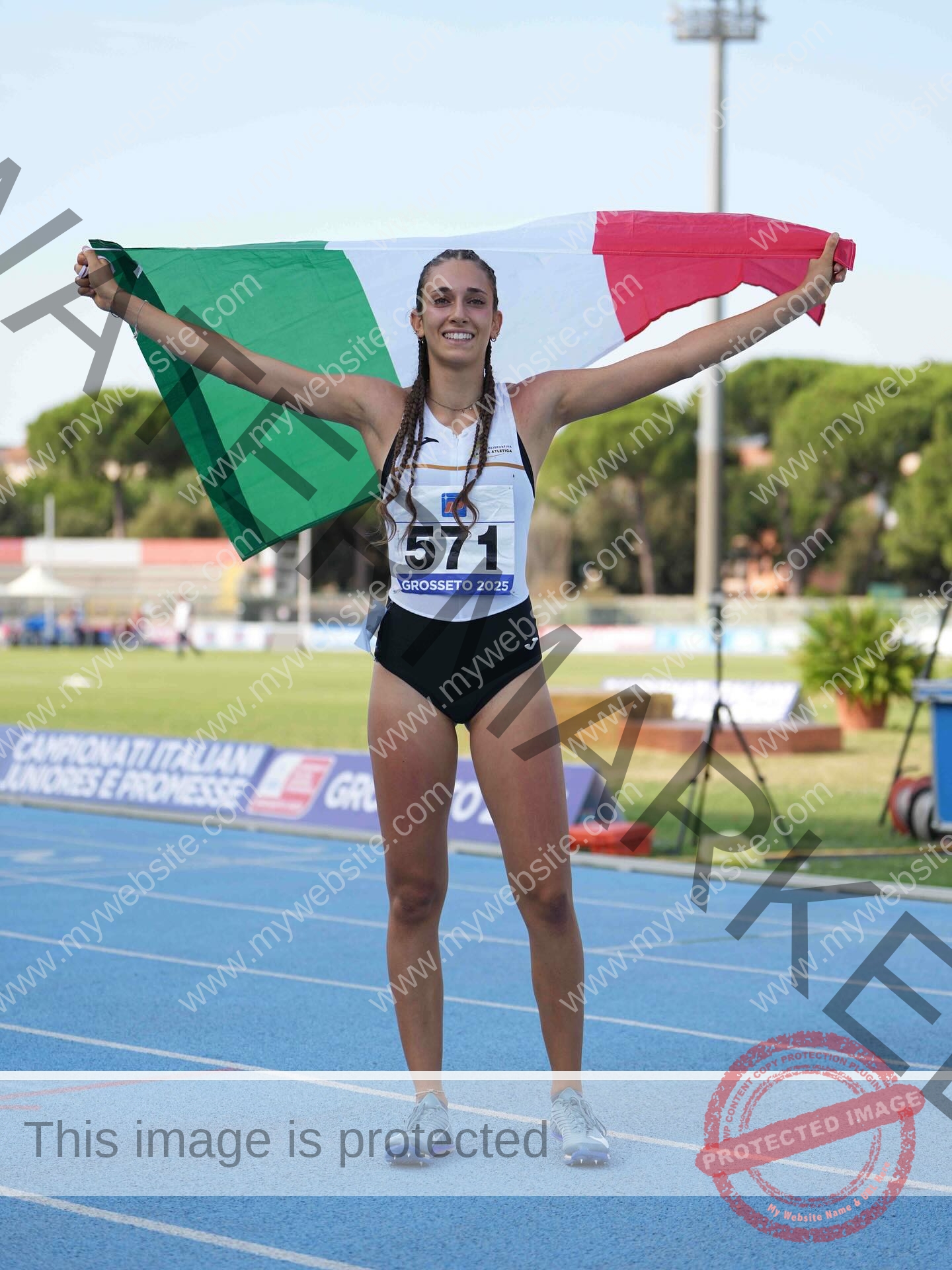
At Grosseto, she won. The Italian Junior title in the 100 meters hurdles went to Cioccoloni, with a winning mark later confirmed as 13.81 seconds — her junior season best and the FIDAL standard required for the European U20 Championships. The Lazio athletics federation’s post-championships report confirmed the title: “110hs/100hs: Matteo Togni (Fiamme Oro) e Veronica Cioccoloni (Astra Atletica).” It was her first national title in the senior hurdles category and came, at 17, in her very first year as a junior-category athlete. Winning an Italian national title at junior level in any event is a significant achievement; winning it in the 100 meters hurdles — one of the more competitive women’s events in Italian youth athletics — is genuinely impressive.
The Grosseto result also confirmed her participation in the European Under-20 Championships at Tampere, Finland, where Italy would send three athletes in the women’s 100mH: the headline entrant Alessia Succo (who had run the extraordinary time of 13.20 with junior-height barriers — a U20 Italian record — at just 16 years old), Matilda Lui, and Cioccoloni.
European Under-20 Championships, Tampere 2025
The 2025 European Athletics Under-20 Championships at Tampere, Finland, from August 7 to 10, again produced a memorable collective performance from Italy: the Azzurrini won the overall medals table with six golds and fourteen total medals, their best-ever haul at any European or World Youth/Junior event. In a generation that is genuinely remaking the landscape of Italian youth athletics, the Tampere championships felt like a statement of generational arrival.
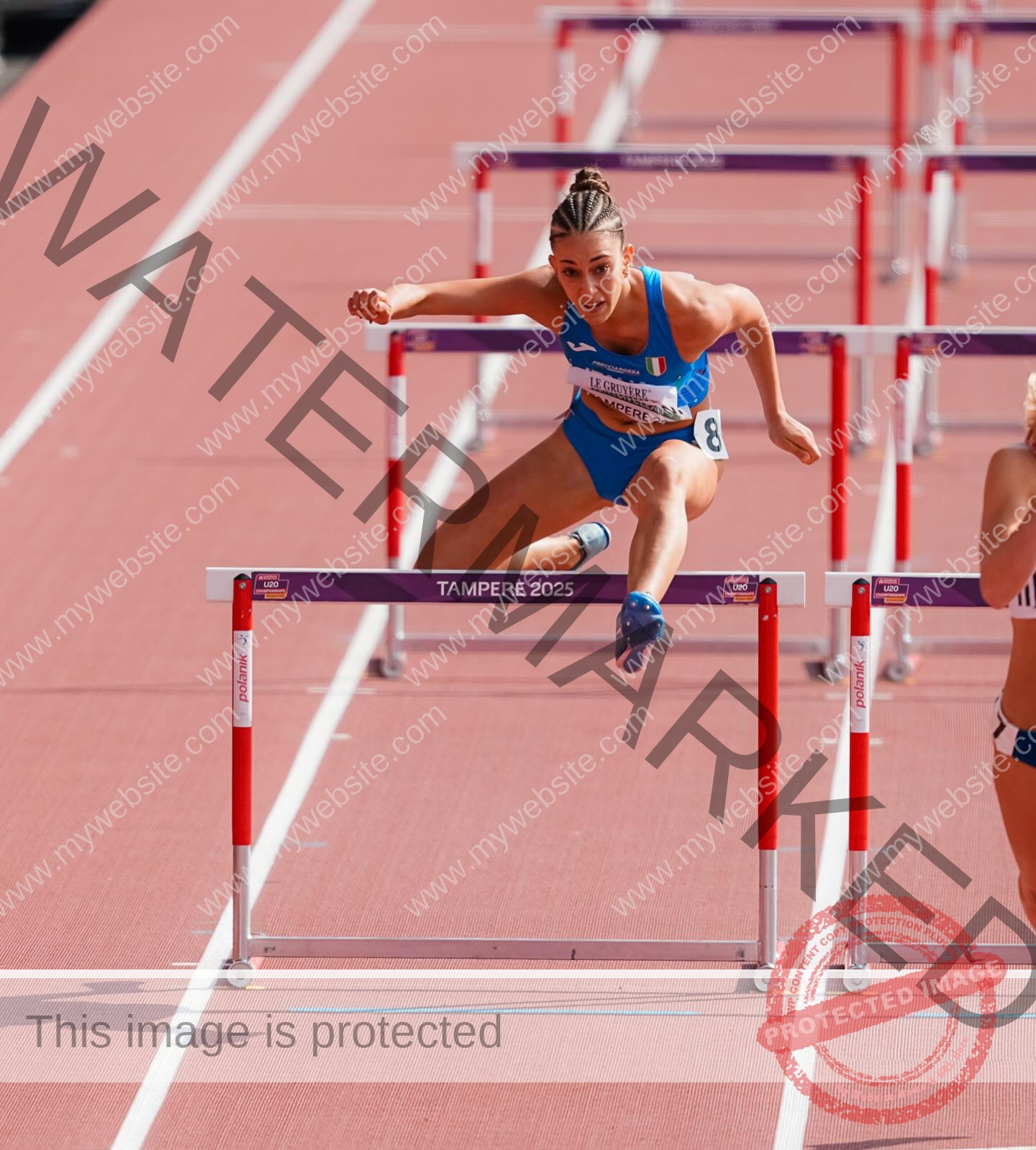
Cioccoloni lined up in the preliminary round of the 100 meters hurdles on the third day of competition. The field, now competing with the taller adult-height barriers (84 cm), was deeper and faster than the U18 fields she had faced a year earlier. In the final preliminary heat, she ran 14.38 seconds into a -0.8 m/s headwind and finished fifth — outside the qualifying positions for the semifinal. She was eliminated in the heats.
A live commentary from OA Sport during the event captured the moment: “Quinta l’azzurra Cioccoloni che chiude con 14.38” — fifth for the Italian, finishing with 14.38. The FIDAL official summary was measured: “Nessun particolare errore per Veronica Cioccoloni, fuori con 14.38 (-0.8).” No specific technical mistakes, simply a time that didn’t advance in a very strong field, on a day when only Alessia Succo went through from the Italian trio (running 13.72 to reach the semifinal, where she would eventually take bronze in the final).
The Tampere experience, taken in full context, is part of Cioccoloni’s ongoing development. She was one of three Italian athletes in the event in the same year she won the national junior title. The gap between a national championship-winning time and a European semifinal place is the gap that the next stage of development — technical refinement, physical maturation, more international racing experience — is designed to close.
Winter 2025–26: Leading Italy’s Junior Lists
The indoor season of 2025-26 opened with Cioccoloni already near the top of Italy’s junior performance lists. A February 2026 FIDAL Lombardia preview for the Italian Junior and Promesse Indoor Championships at Ancona noted that “Matilda Lui (Pro Patria Milano) scatterà con il secondo crono italiano 2026, un 8.52 che dista solo 1/100 dalla leadership di Veronica Cioccoloni (Astra Atletica)” — a single hundredth of a second separated Italy’s top two junior women in the 60mH heading into the indoor championships, with Cioccoloni holding the lead.
At the 2026 Italian Junior Indoor Championships in Ancona on February 7-8, 2026, Cioccoloni took the silver medal in the 60 meters hurdles. The Lazio regional federation’s summary captured the result with a headline-level note: “CIOCCOLONI VICECAMPIONESSA — Veronica Cioccoloni ancora al top. Dopo una stagione outdoor in grande evidenza, il 2026 al coperto parte con il titolo di vicecampionessa italiana dei 60hs.” The phrasing — “ancora al top” (still at the top), and the explicit reference to her “strongly notable outdoor season” — places her silver medal within the context of a broader pattern of high-level performance that has now extended across two calendar years.
She also led Italy’s junior 60mH rankings entering the 2026 indoor season with an 8.51 mark, and an atletica.me performance profile confirms her career best in the indoor hurdles at 8.48 seconds — a mark that places her solidly among Italy’s elite junior hurdlers.
Personal Bests and Career Marks
As of early 2026, Veronica Cioccoloni’s documented personal bests include:
- 60m Hurdles (Indoor): 8.48 seconds — Ancona
- 100m Hurdles (Outdoor): 13.81 seconds — Grosseto (Italian Junior Championship, 2025)
- 100m Flat: 12.36 seconds — Cesena
- 60m Flat: 7.86 seconds — Ancona
- Long Jump: 5.54 meters — Rieti
- High Jump: 1.59 meters — Rieti
- Pentathlon (Indoor): 3376 points — Padova
These marks collectively describe an athlete with a solid sprint base, technical hurdles capability, and enough versatility across jumping events to compete credibly in the pentathlon — a multi-event discipline that the Italian system uses to develop complete athletes. Her 12.36 in the flat 100 meters provides the speed foundation for a hurdles career that will likely see further progression as she matures physically and refines her technical approach to the barriers.
The 13.81 outdoor personal best in the 100mH is a mark that, in the context of European junior athletics, represents genuine competitiveness. At the 2024 European U18 Championships, it would have been sufficient to qualify from the heats. At the U20 level, the field is faster, but the trajectory of Cioccoloni’s development suggests there is significant room upward.
No World Athletics Profile Yet — Context for This Stage
As of early 2026, Veronica Cioccoloni does not have a confirmed World Athletics athlete profile. This is entirely consistent with her career stage. World Athletics profiles are typically created when athletes compete in major international competitions or begin to register marks at the senior level on the global scene. At 18, with international experience limited to two European youth championships, Cioccoloni is at the threshold of the stage at which such a profile would logically be created — particularly if she continues to develop and competes at further FIDAL-sanctioned international events.
Club and Environment: Astra Atletica, Rome
A.S.D. Polisportiva Astra Atletica is a Roman sports club whose athletics section operates under FIDAL registration code RM367. The club trains, by its own account, a large and diverse youth population, with the athletics section described as one of the “rialtà di rilievo” — leading realities — of Lazio’s and Italy’s youth athletics landscape. The club identifies itself through the founding motto “Per Aspera Ad Astra” — a phrase that elegantly connects the Latin name to a philosophical commitment to perseverance and excellence.
Cioccoloni has trained and competed under Astra Atletica throughout her competitive career. That consistency of club affiliation, from her early cadette years through her breakthrough allievi season and into her junior career, speaks to a training environment that has served her well. Rome’s athletics infrastructure — with facilities at venues like the Stadio dei Marmi and the Stadio del Guidobaldi in Rieti nearby — provides the competitive context in which she has developed.
The Landscape Around Her: Italy’s Junior Hurdles Generation
To appreciate where Cioccoloni stands within Italian athletics, it helps to understand the hurdles generation she has been part of. The women’s 100 meters hurdles in Italian junior athletics is genuinely competitive. In her age group and the two years above, she has raced against:
Vittoria Masiero — the Italian U18 champion in 2024 (13.51), who has been her closest domestic rival over the hurdles. Matilde Morbin — who shared the billing with Cioccoloni as the two leading Italian junior hurdlers heading into the 2025 season. Alessia Succo — the younger prodigy born in 2008-2009 who ran 13.20 in 2025 to set the Italian U20 record with junior-height barriers, a mark that generated significant attention. And Isabella Calzolari, Sofia Gragnato, and others who have traded performances in the lists throughout 2024 and 2025.
Within this competitive field, Cioccoloni’s Italian junior title at Grosseto in 2025 stands as a meaningful data point: in a season with a very deep competitive pool, she ran the fastest qualifying mark, won the national championship, and earned the European berth. That is a competitive result, not a lucky one.
Looking Forward: The 2026 Season and Beyond
Veronica Cioccoloni enters the 2026 outdoor season as an 18-year-old in her second year of junior eligibility. The major targets for the year include the Italian Junior Championships and the potential path to the World Athletics Under-20 World Championships, which FIDAL has been building toward as a major junior event. She is a pre-season favorite or strong contender for Italian junior medals in both the 60mH (indoor) and 100mH (outdoor), and the Ancona indoor silver in February 2026 confirms she continues to develop.
The Lazio athletics federation’s summary framing of her 2026 indoor silver — “ancora al top” after a “stagione outdoor in grande evidenza” — captures the narrative of a young athlete who has established a consistent level of performance and is building on it year over year. She is not a flash-in-the-pan result or a single-meet wonder. She is an athlete who has now shown high-level performance across multiple competitive seasons, at multiple types of competition (regional, national, and continental), in multiple formats (outdoor and indoor).
The next steps are ones she has already been navigating well: sub-13.5 in the outdoor 100mH would mark a significant level-up; reaching a European U20 semifinal or final before her junior eligibility ends would cap a meaningful developmental arc; and the senior national team, where Italian hurdlers like Giada Carmassi and Elisa Di Lazzaro have set the standard, represents the longer horizon. All of that is ahead. In the meantime, per aspera ad astra.
Social Media and Public Presence
Veronica Cioccoloni is active on Italian athletics platforms. Her performance profile is maintained on atletica.me, the primary Italian athletics statistics database, under her name and club affiliation. FIDAL’s national system tracks her results through the Lazio regional committee. The club Astra Atletica maintains a web presence at astratletica.com and references her achievements as a source of institutional pride.
No confirmed personal social media handles for Cioccoloni have been independently verified in publicly available sources at the time of writing, consistent with her age (18) and the general discretion maintained by younger Italian athletes without major sponsorship arrangements. As a junior athlete without current commercial sponsorship ties, her public-facing presence flows primarily through FIDAL’s institutional channels and through coverage from Italian athletics media outlets including atleticamagazine.it, atleticalive.it, and the FIDAL regional websites.
