





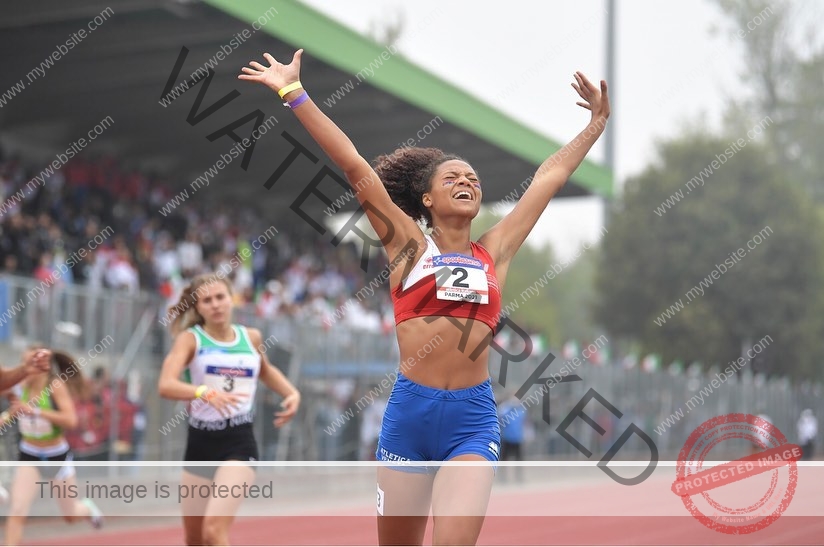
Rebecca Agbortabi
Treviso’s Multi-Event Sprinter Is Writing Her Own Chapter in Italian Athletics
The story of Rebecca Agbortabi begins, like many of the best athletic stories, somewhere unexpected: on a school playground in Treviso, where a girl discovered she could run faster than almost everyone around her — including the boys. That discovery set in motion a chain of events that, within just a few years, would see her standing on the podium at the Italian national youth championships, running legs on relay teams that captured regional titles, and ultimately transitioning from one of Italy’s most electrifying young sprinters into a genuine dual-threat athlete in both the horizontal jumps and the short sprints. Born on October 22, 2006, Rebecca Agbortabi is a product of the Veneto region, a competitor at Trevisatletica — one of the province’s most prestigious athletic clubs — and, by any reasonable measure, one of the more interesting young athletes in Italian track and field.
A Family From Three Continents
Rebecca’s background is genuinely unusual, and in the best possible way. Her father, St. John Agbortabi, is originally from Cameroon, in Central Africa. He settled in Italy and became a hip-hop dance instructor — a career that gives some texture to his daughter’s athleticism and physical expressiveness. Her mother, Volha, is from Belarus. The two met in Belarus while St. John was studying there, then relocated to Italy, where they have raised their family in the San Giuseppe neighborhood of Treviso. Rebecca, born in October 2006, is the youngest of three children; her siblings are Riccardo and Emanuela.
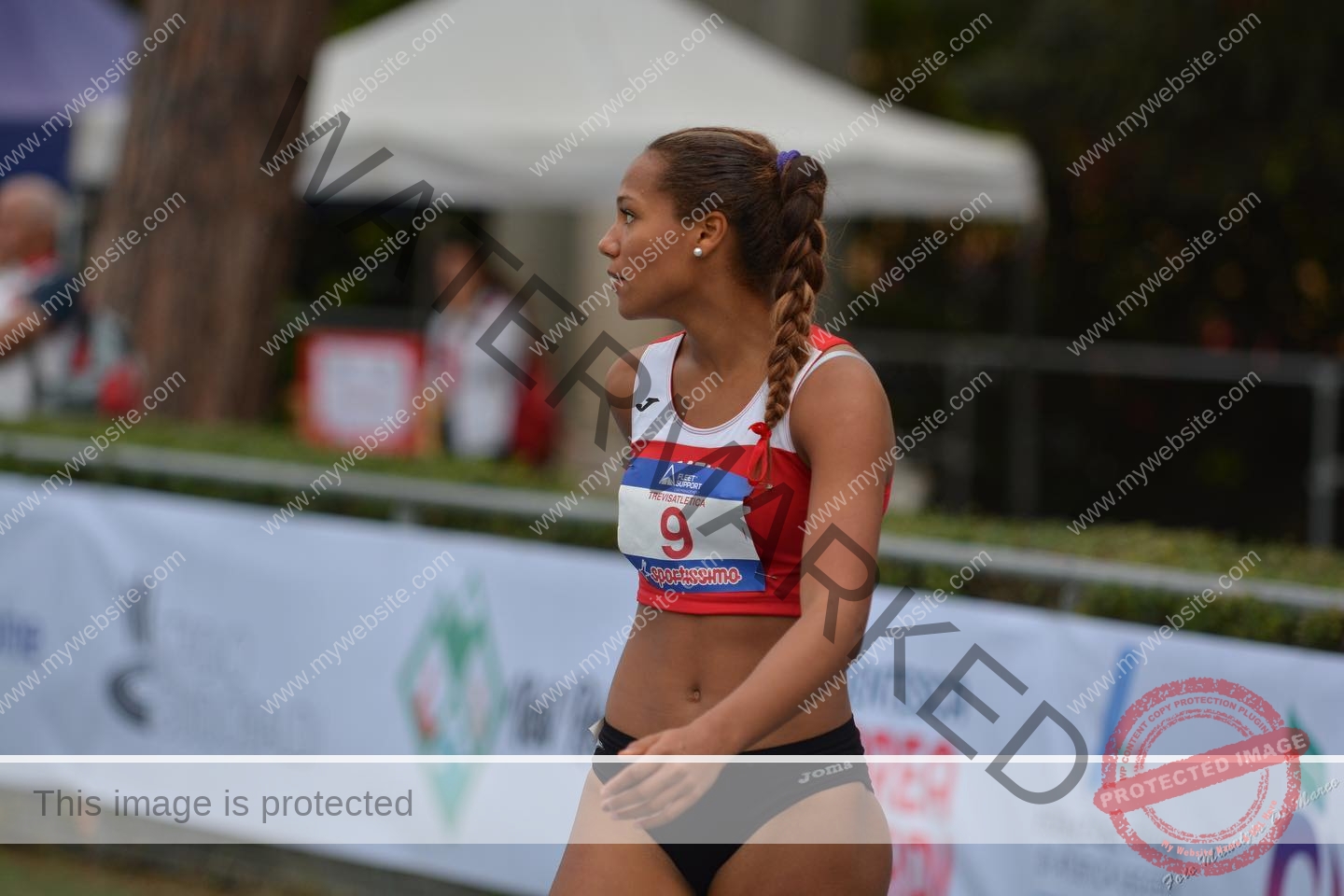
It is a family with a competitive athletic instinct distributed across three sports: Riccardo and Emanuela have both been involved in volleyball and basketball, making the Agbortabi household one of those rare sporting families where nearly every conversation comes with some scoreboard context attached. Rebecca, as her father put it to a local journalist in 2021, is “the first of her siblings to betray the family passion for the ball” — opting instead for the individual competition of the running track. Her primary coaches at Trevisatletica, Rolando Zuccon and his wife Mary Massarin (herself a former hurdles international for Italy), have shaped her development from the beginning.
Her own explanation for how it all started is refreshingly simple: “I liked running. At school I often beat even the boys. One day my dad took me to the San Lazzaro track. And that was the beginning.” The track at San Lazzaro, a short distance from the family home, became her training ground, and Trevisatletica became her competitive home. The results that followed were anything but simple.
Early Development: The Ragazze Years
Rebecca’s first documented competitive results at the provincial level go back to the ragazze (under-12) category, where she already stood out in multi-event competition. In May 2019, at the provincial championships in Pederobba, she won the girls’ tetrathlon — a four-discipline youth combined event covering 60-meter hurdles, vortex throw, long jump, and 600 meters — with 2,678 points, finishing comfortably clear of her Trevisatletica teammate Beatrice Buso in second. Even in that early provincial result, a consistent pattern was already visible: strong across multiple events, fastest in the sprints, with a long jump component that would become increasingly central to her portfolio as she grew older.
She was training five sessions per week under Zuccon’s careful management of workload — what her coach described in 2021 as “appropriate loads for her age, without ever exceeding.” The physical gifts were obvious: by the time she was 14, she stood 1.80 meters tall and carried what would prove to be genuine sprinting speed and explosive power in her stride. But the coaching philosophy at Trevisatletica has always been patient and systematic, and that approach has paid dividends over time.
The Cadette Breakthrough (2021): Italy’s Best Under-16 Sprinter
The 2021 season, Rebecca’s first in the cadette (under-16) category, was an explosion. It began in May, when she took to the track at Treviso for an 80-meter hurdles competition and ran 12.4 — competitive by any standard for the age group. Then, barely two weeks later, she made national news.
On May 9, competing on her home track at San Lazzaro in Treviso, she ran the 300-meter hurdles for the very first time in her competitive life. The result — 45.1 seconds — was the best time in all of Italy for under-16 girls in that event for the season. Two weeks after that, at the Atletica Triveneta Meeting in Modena, she ran the flat 300 meters for just the second time that season and clocked 39.8 seconds — again, the best time in Italy for under-16 girls in the event at that point in the season. She was holding both national seasonal leads simultaneously in two different events, in a category she had just entered.
The local Treviso press took notice immediately. The headline in La Tribuna di Treviso, Treviso’s main newspaper, captured the moment: “Agbortabi, what a missile — the young star of Trevisatletica is the best under-16 in Italy.” The article explained the family background, the schoolyard running, the hip-hop dancing father, and the measured coaching of Zuccon, who was careful to temper expectations while acknowledging the obvious quality in front of him: “The talent is still entirely raw.”
Then, on June 6 in Modena, she improved the 300 meters mark to 39.10 — a time that still stands as her career personal best in the event and that placed her fifth on the all-time list of Italian cadette women in the 300. A few weeks later, at the regional championships in Abano Terme, she ran 44.86 for the 300-meter hurdles — again the best in Italy among under-16 women at that point — breaking the sub-45 barrier on just her second competitive appearance in the event.
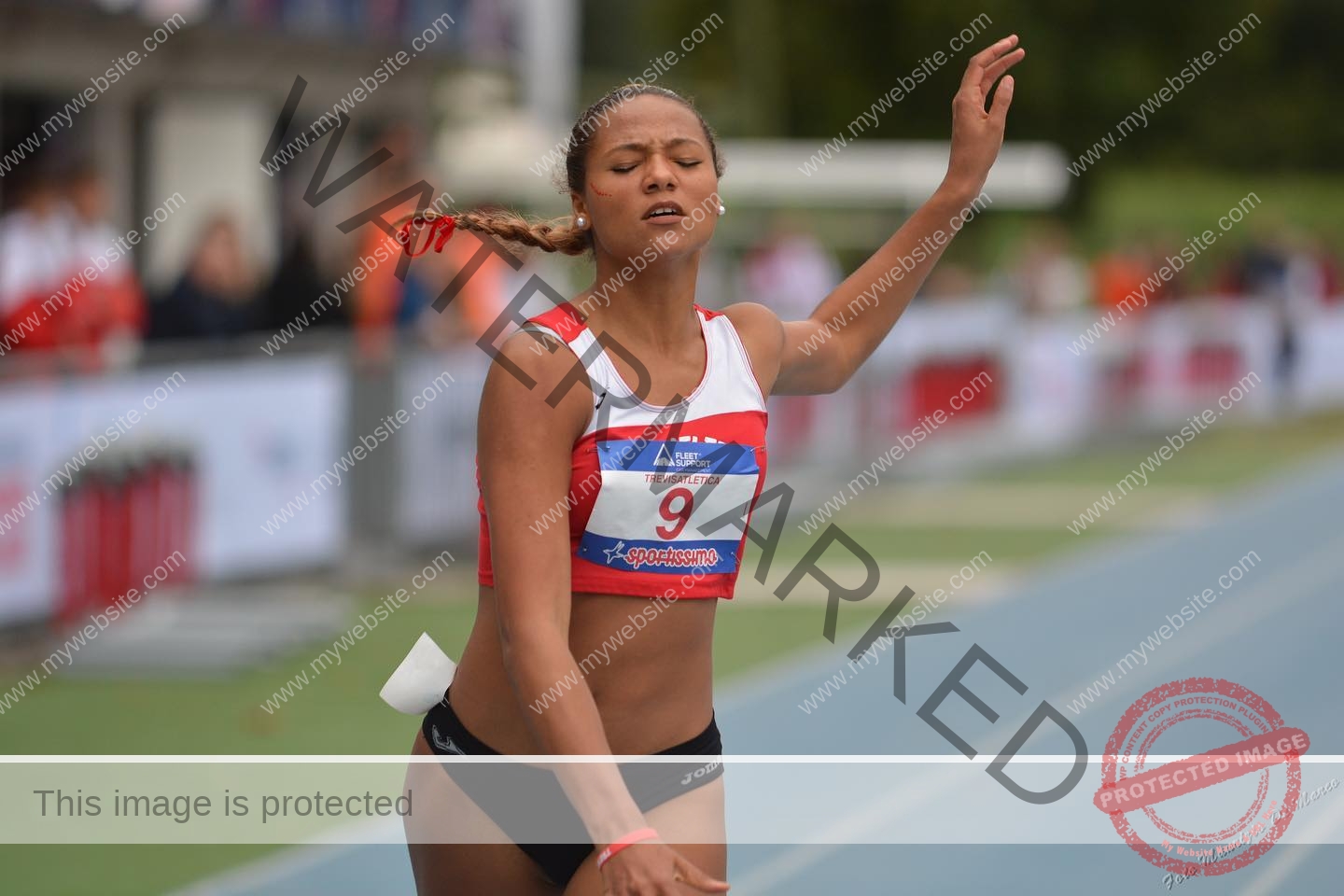
The season culminated at the Italian Cadet Championships in Parma, held in October. Rebecca arrived as a clear favorite in the 300 meters, and she delivered exactly what was expected. She ran 39.92 in the heat and 39.66 in the final to claim the national title — one of only two Italian cadette women to go under 40 seconds in the entire season, and she had done it five times. Then, on the following day, she ran the anchor leg for the Veneto regional 4×100 relay team and turned what had been a deficit into a victory with a finishing burst that club officials compared, with obvious delight, to the famous Filippo Tortu anchor at the Tokyo Olympics. Two gold medals from the national championships. The Veneto 4×100 team title was secured in significant part because of her relay contribution.
The Italian athletics federation’s official race recap from Parma described her story for a national audience for the first time, noting that her father was from Cameroon and her mother from Belarus, and that her parents had met in Belarus while her father was studying there before both relocated to Italy — a detail that gave her distinctive surname its full context to readers unfamiliar with her family history.
The Move Up to Allieve (2022): New Events, New Personal Bests
The transition to the allieve (under-18) category in 2022 brought with it a wider range of competitive distances and events. At that level, the 300 meters as a standalone event gives way to the 400, and the 80-meter hurdles of the cadet years become the 100-meter hurdles; the full relay schedule expands considerably.
Rebecca’s allieve season showed a runner finding her place in the new landscape. At the regional team championships in Verona in May, she ran 25.31 seconds for the 200 meters — a personal best at the time — finishing second. Later at the same meet she added a 59.14 for 400 meters, winning the 400-meter allieve race. Both performances confirmed her profile as a genuine sprint versatility athlete capable of covering the 200 and 400 with equal authority.
The season’s performance highlight came at the Raiffeisen Arena in Bressanone in late May, where Trevisatletica’s women’s relay squad ran 46.86 for the 4×100 meters — a mark that World Athletics has logged as the best performance on its scoring tables among her career bests. In the same competition weekend, she ran 24.82 for 200 meters, which remains her personal best in that event and her second-highest performance by World Athletics score.
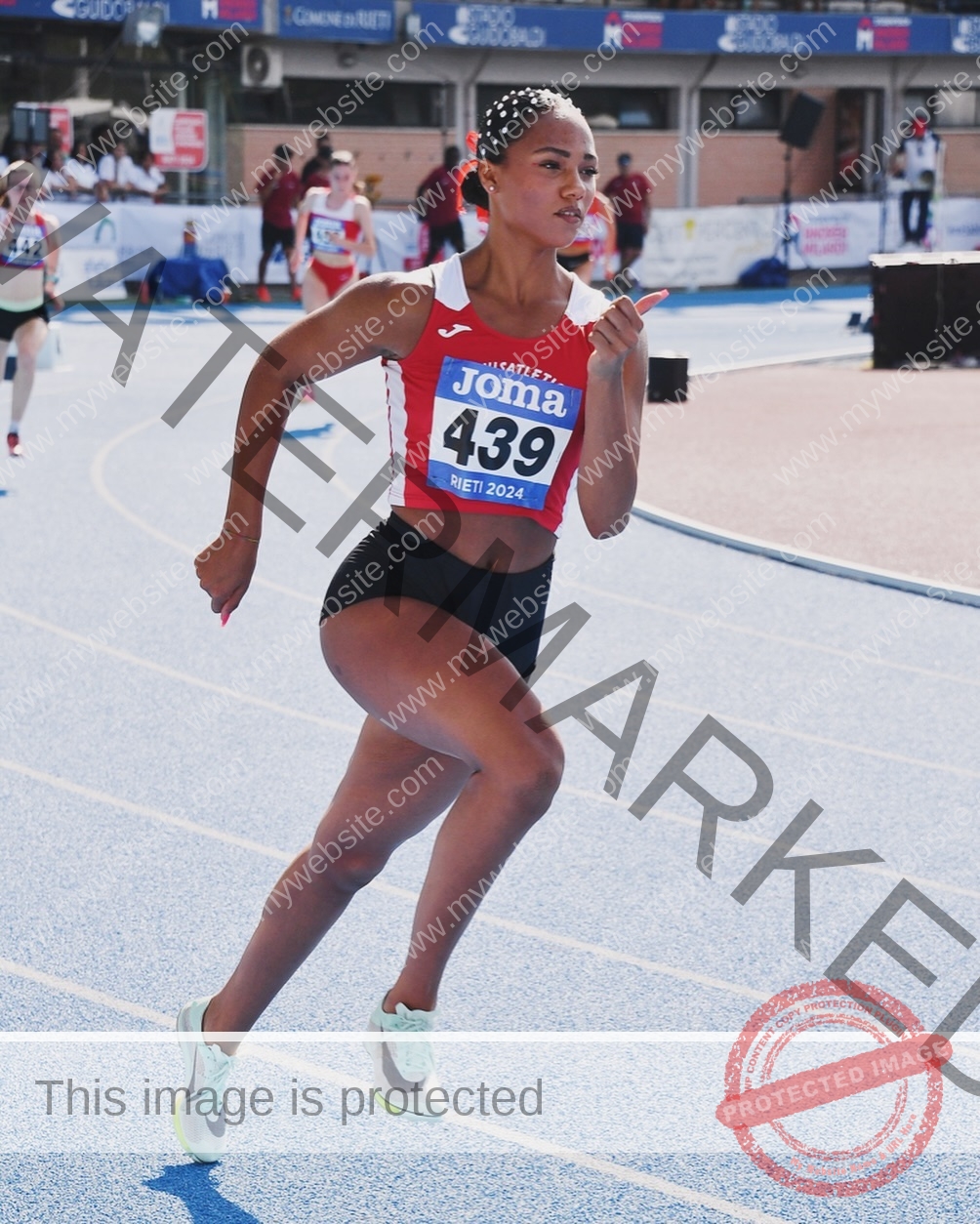
At the Italian Allieve Championships in Milan in June, she placed fourth in the 100 meters (12.70) and took bronze in the 200 meters (25.71, into a headwind of -1.0), narrowly missing the national title by less than 0.7 seconds. She was also part of a Trevisatletica 4×400 relay team that finished fifth at the national championships. By the end of the season, she had placed in the top ten nationally in both the 100 and the 200, confirming a competitive range that many sprinters of her age could not match.
The club’s season summary described her 2021 cadette performance as the springboard for what came in 2022: “The return to the national championships saw the two-time 2021 Italian cadette champion Rebecca Agbortabi compete in the 200.” The “two-time” designation — acknowledging both the 300-meter title and the 4×100 gold at Parma — remained a point of pride in the Trevisatletica record books.
At the Italian Allieve Championships team finals in Rieti in September, Rebecca claimed a bronze medal in the 200 meters (25.71, with a -1.0 headwind), with Trevisatletica’s women ending seventh overall as a club in the national final. The club president, Rolando Zuccon, called the seventh-place finish “a result without precedents” for the club, noting that Trevisatletica was the sixth-strongest under-18 program in Italy when combining the men’s and women’s scores.
Growing Into the Senior Programme: 2023 Onward
From 2023 onward, Rebecca’s competitive trajectory began to show something new: a growing investment in the long jump alongside her sprint events. This is a natural evolution for a physically gifted sprinter with the combination of height, fast-twitch musculature, and take-off power that she clearly possesses. At 1.80 meters, with the speed she had demonstrated across the sprint distances, the horizontal jumps represented a logical avenue for additional competitive development.
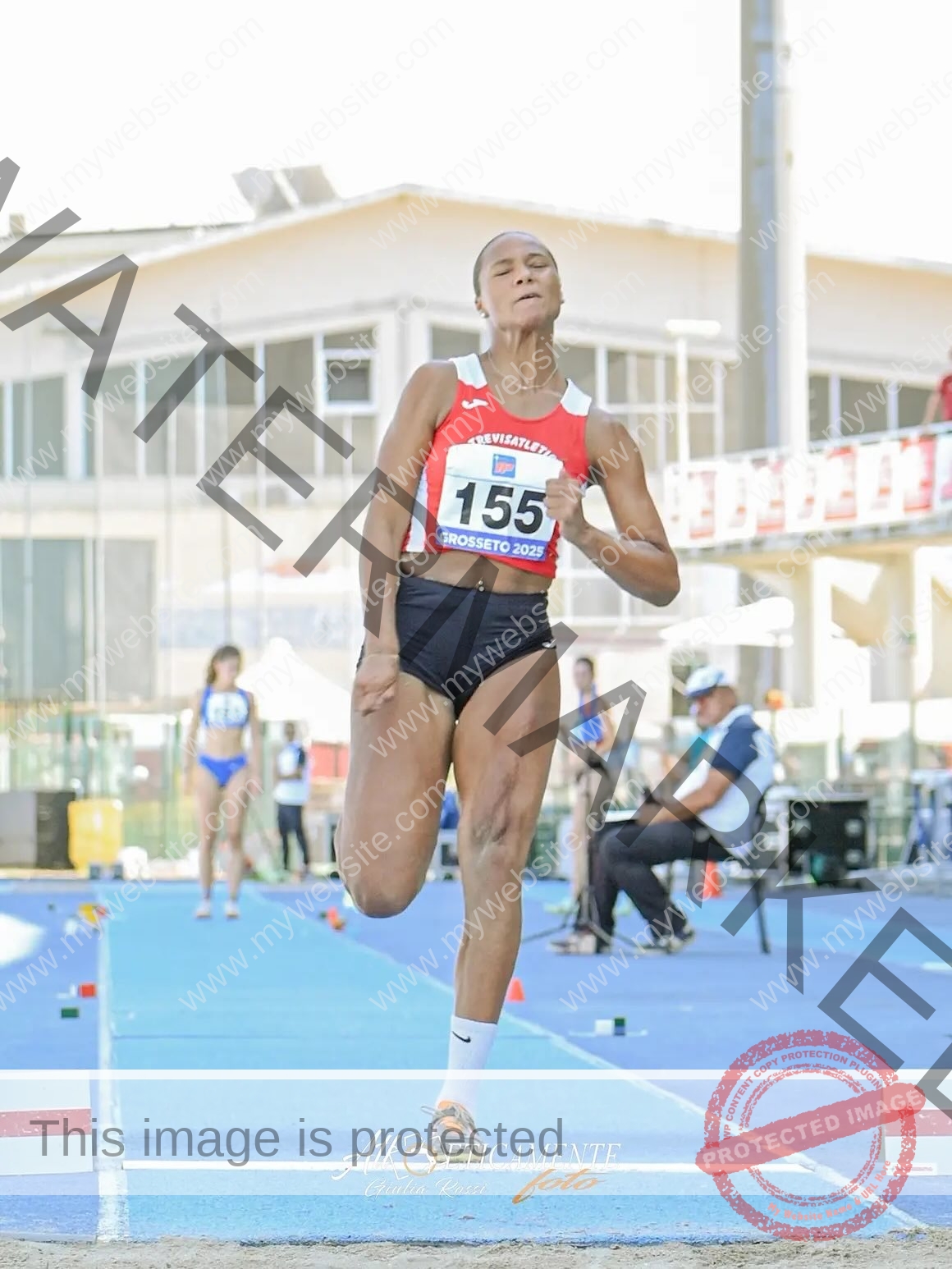
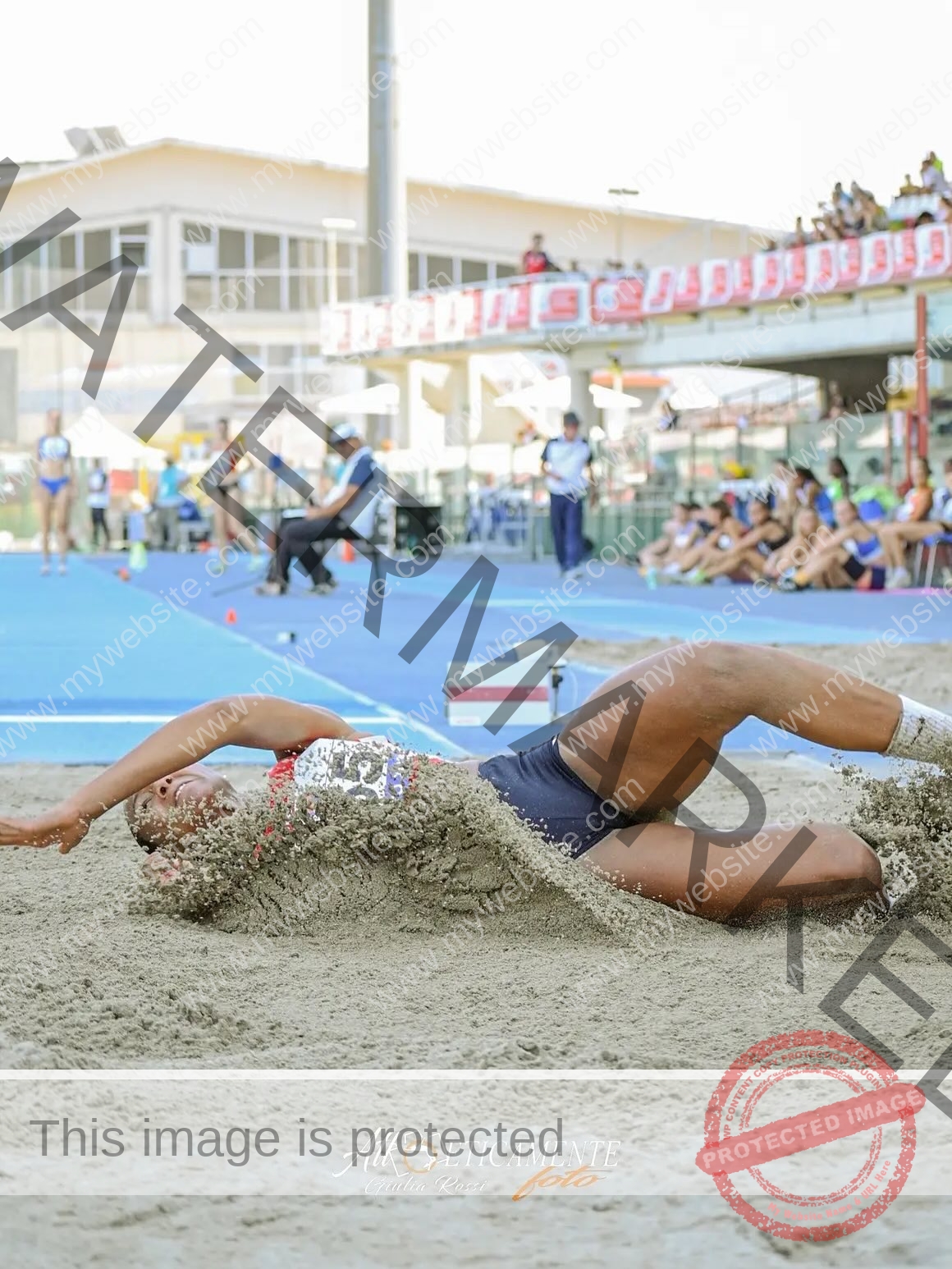
By 2025, the transition to the long jump as a co-primary event was well underway. At the Italian Junior and Promesse Championships in Grosseto in July 2025, she competed in the long jump against the national field, producing 5.80 meters on her third jump — a mark that sits as her current personal best in the event and the mark that World Athletics now logs alongside her sprint bests as a key career performance. The competition at Grosseto was competitive, with the final positions not shifting in the additional rounds, but 5.80 is a meaningful result for a first-year junior jumper still developing the technical foundations of the event. That performance placed her inside the World Athletics top 1,500 in the women’s long jump globally — a reference point that will move considerably as she continues to grow in the event.
At the club level in 2025, Trevisatletica listed her as the primary representative in the long jump at the Italian Club Championships, alongside her continued role in the 4×100 relay and the 4×400. A club preview for the June 2025 team championships confirmed her dual-event status: she was entered in the long jump as a field event competitor and simultaneously listed as a member of both the 4×100 sprint relay and the 4×400 relay, covering arguably the widest individual event range of any athlete on the Trevisatletica women’s roster.
Personal Bests (as of June 2026)
| 4x100m Relay | 46.86 — Bressanone, May 29, 2022 |
| 300m | 39.10 — Modena, June 6, 2021 |
| 200m | 24.82 — Bressanone, May 29, 2022 |
| Long Jump | 5.80m — Grosseto, July 5, 2025 |
| 4x400m Relay | 3:53.36 — Milan, June 19, 2022 |
| 400m | 59.14 — Verona (regional championships, 2022) |
| 300m Hurdles | 44.53 — Abano Terme, July 2, 2021 |
The Athlete in Full: What Makes Rebecca Agbortabi Interesting
Several things set Rebecca Agbortabi apart from the typical young Italian sprint talent. The first is the breadth of her competitive range. From the 80-meter hurdles of her early youth career, through the 300-meter flat and the 300-meter hurdles at the cadette level, into the 200 and 400 as an allieva, and now into the long jump as a junior — she has never been an athlete who fits comfortably into a single narrow speciality. Her coaches have not forced the issue, allowing events to come and go as her development has demanded, which is the mark of a program that thinks in years and not just seasons.
The second is the context of her background. Growing up in the northeast Italian city of Treviso with Cameroonian and Belarusian heritage, in a household where hip-hop dance and three competitive sports ran simultaneously, Rebecca arrived at athletics through an entirely organic route. She did not come from a running family. She was not pushed into the sport. She went to the track because she liked running fast, and everything that followed has been built on that intrinsic motivation.
The third is the quality of the club environment she competes within. Trevisatletica, under president Rolando Zuccon and with coaches like the ex-national hurdles competitor Mary Massarin, has built one of the more coherent youth development programs in the Veneto region. The fact that Rebecca’s two Italian cadet championship gold medals in 2021 were won alongside teammates Anita Nalesso (who dominated the shot put at the same championships) and Beatrice Buso (silver in the 300 hurdles) speaks to a club that develops athletes comprehensively rather than betting everything on individual stars.
World Athletics Profile and Rankings
Rebecca Agbortabi holds World Athletics athlete code 14978814. Her profile lists her primary events as the 300 meters, 200 meters, long jump, and 200 meters indoors, with additional appearances recorded in the 100 meters, 400 meters, 4×100 relay, 4×400 relay, 300-meter hurdles, and 60 meters. Her current World Athletics ranking places her at #1456 globally in the women’s long jump, reflecting a field that includes many thousands of athletes worldwide; that ranking will move considerably as she accumulates more competition results in the event.
The scoring table evaluations give a fair picture of her career performance levels. The 4×100 relay time of 46.86 scores 1018 points — the highest-rated individual performance in her career. The 300 meters at 39.10 scores 1005 points. The 200-meter personal best of 24.82 scores 958 points. The long jump of 5.80 meters scores 955 points. The 4×400 relay time of 3:53.36 scores 950 points. These are consistent numbers across sprint and jump events, confirming a genuinely multi-disciplinary competitive profile rather than a single event specialist.
The Broader Context: Italian Women’s Sprint and Jump Landscape
Italian women’s sprint and horizontal jumping events have seen considerable development in recent years. In the 200 meters, the national open scene is increasingly competitive, with times in the 23.00–24.00 range now required for top domestic finishes. Rebecca’s 24.82 personal best places her in a competitive bracket at the junior level and provides a meaningful foundation for improvement as she enters her promesse (under-23) years. In the long jump, the Italian women’s event has produced some genuinely elite performers over the years; Rebecca’s current 5.80 meters places her at the competitive threshold of the national junior landscape, and there is ample room to develop technically in an event she has only recently adopted as a serious speciality.
What is clear from her complete competitive history is that she is an athlete who has never been defined by a single mark or a single year. The 2021 cadette season that put her on Italy’s national athletics radar as a 14-year-old was followed by a creditable allieve campaign that extended her range into the full allieve sprint program. The subsequent years have seen her expand into the long jump while maintaining her relay contributions and sprint presence. At 19 years old, she is at precisely the age when athletes begin converting the multi-event versatility of youth into a more focused senior profile — and the question of where that focus ultimately lands, whether on the long jump, the sprints, or some combination of both, is one of the genuinely interesting open questions in Italian junior athletics.
Club and Regional Standing
Trevisatletica is one of the competitive pillars of athletics in the province of Treviso, a region with a strong athletics tradition. The club, led by president Rolando Zuccon, competes at the top levels of the Italian team championships system and has a roster of 355 athletes as of 2025. Rebecca has been central to the women’s sprint relay units throughout her career, contributing to 4×100 and 4×400 relay squads that have competed at regional and national team championship levels consistently. Her 2021 contribution to the Veneto regional 4×100 title — anchoring the team from behind and overhauling the competition in the final stretch — remains one of the signature performances the club celebrates in its competitive history.
Her trainers, Rolando Zuccon and Mary Massarin, have maintained a consistent approach throughout her development: build the aerobic and speed foundations first, let the event specialization follow naturally, and never push a young athlete beyond what their age and physical development can sustain. That approach produced a national champion at 14 and a versatile senior competitor by 19, which is about as good an advertisement for patient youth development as Italian athletics can offer.
Social Media and Public Presence
Rebecca Agbortabi maintains a presence on social media consistent with a 19-year-old athlete whose primary focus remains competition and development. Her club, Trevisatletica, maintains an active online presence and documents its athletes’ performances regularly through local media partners in the Treviso area. The Italian athletics federation database at atletica.me lists her full results history under her name with Trevisatletica. No confirmed external commercial sponsorship arrangements beyond those provided through club affiliation have been publicly reported. Notably, the Atletica.me platform lists 22 people who follow her results there, a number that will almost certainly grow as her junior-to-senior transition continues.
Looking Forward
The next phase of Rebecca Agbortabi’s career will be defined by what happens when she commits more fully to the long jump alongside her sprint events, and whether the technical development of the jump catches up with the raw athleticism she has always possessed. A 1.80-meter sprinter with a 24.82 personal best in the 200 and a 59.14 in the 400 — already at the threshold of the long jump sandbox at 5.80 meters — is an athlete that Italian jump coaches will pay close attention to as she moves through her junior and promesse seasons.
She is also an athlete whose story carries a resonance beyond the stopwatch and the measuring tape. The girl from a Treviso schoolyard — daughter of a Cameroonian hip-hop instructor and a Belarusian mother — who discovered she could run faster than the boys, who was guided carefully by two dedicated coaches at a regional club, who won her first national titles at 14 through a combination of raw speed and competitive composure — that story is not yet finished. It may, in fact, be only beginning.
